



How to Detangle Matted Dog Fur Safely
That hard little knot behind the ear? It never stays little for long. If you are wondering how to detangle matted dog fur without turning grooming into a wrestling match, the trick is less brute force, more prep, patience and the right coat-care routine.
Mats are not just messy-looking fluff. They pull on the skin, trap moisture, collect dirt and can make your dog seriously uncomfortable. In thicker or curlier coats, they can hide close to the skin where things get sore fast. So yes, a tangle is cosmetic. A mat is a comfort issue.
Why mats happen so quickly
Most mats start with friction and neglect, not bad luck. Collars rub. Harnesses rub. Behind the ears gets damp. Legs pick up burrs, sand and general backyard chaos. Add a soft undercoat, a longer topcoat or a curly texture and the coat starts felting together before you have even noticed.
Bathing can make the problem worse if a tangled coat gets soaked without being brushed through first. Water tightens knots. So does shampoo scrubbed in circles. That is why dogs can come out of the bath looking fluffy on top and secretly matted underneath.
Before you detangle matted dog fur
Start by checking how bad the matting really is. If the coat has a few isolated knots, you can usually work through them at home. If the mats are tight to the skin, widespread, smell musty or seem to be pulling when your dog moves, it is time to be realistic. Some matting is beyond a home brush-out and needs a professional groomer.
That is not giving up. It is good judgement. Tight mats can hide redness, hot spots and even tiny skin tears. Trying to rip through them with a slicker brush is a quick way to make your dog hate grooming, and fair enough.
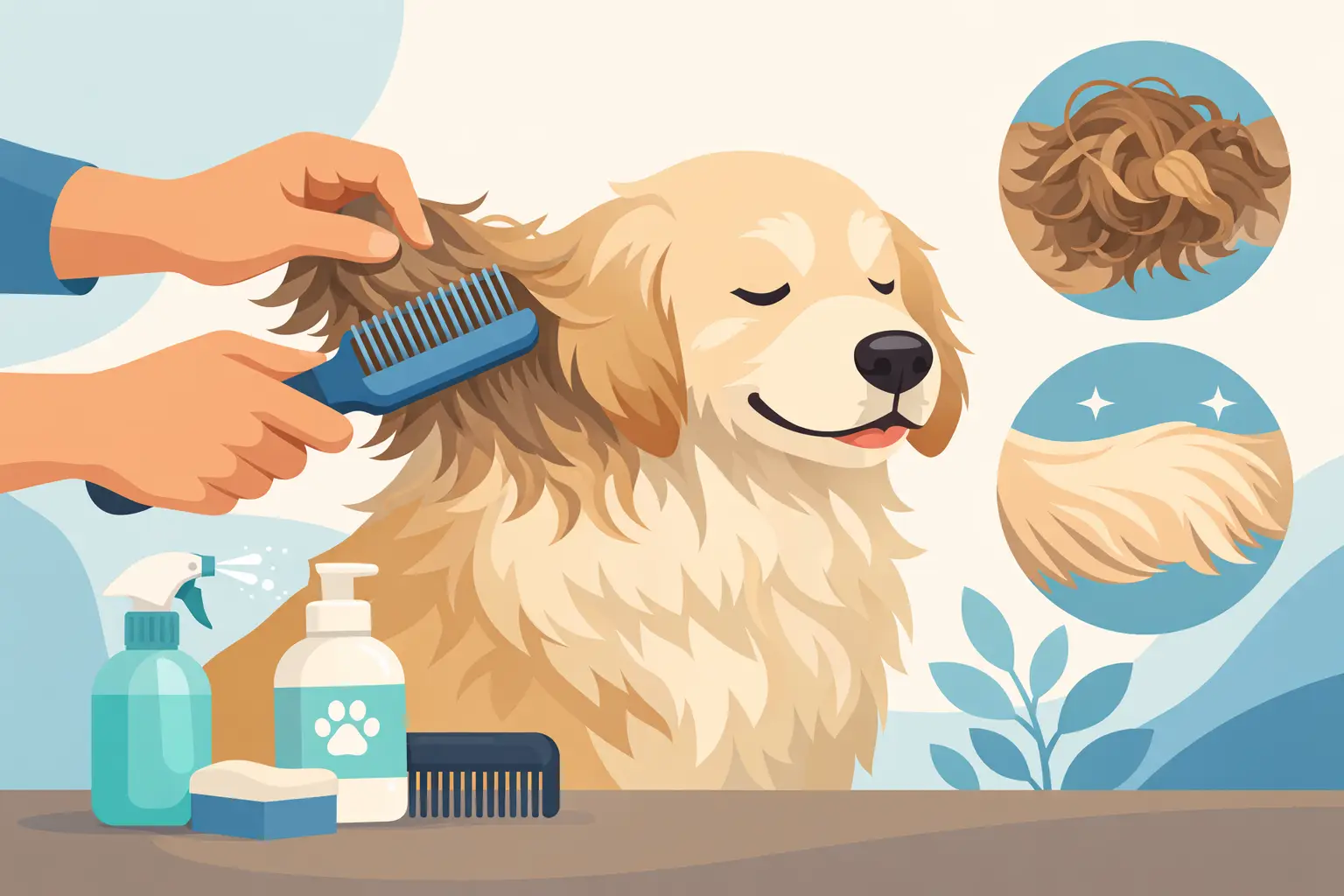
For manageable matting, set yourself up properly. You want a detangling spray or conditioning mist, a slicker brush, a wide-tooth comb and, for thicker knots, a dematting tool used very carefully. Keep treats nearby and choose a calm time of day when your dog is not already bouncing off the walls.
How to detangle matted dog fur at home
The biggest mistake people make is brushing a dry mat. Dry hair grabs, breaks and pulls. A lightly coated, conditioned knot has more slip and far less drama.
1. Prep the coat first
Mist the matted area with a detangling or conditioning spray and let it sit for a minute or two. You want the hair softened, not drenched. If the coat feels brittle, add a little more product and work it in gently with your fingers.
For dogs who mat regularly, a coat-care routine matters just as much as the brush itself. A quality shampoo and conditioner made for manageability can make future grooming much easier, especially on long, curly or double coats.
2. Hold the base of the mat
Use one hand to hold the fur close to the skin while you work with the other. This reduces the pulling sensation for your dog. If you skip this step, even gentle brushing can feel like someone yanking your hair from the roots. Not cute.
3. Start at the edges, not the middle
Use your fingers first to tease apart the outside of the mat. Then take a comb or slicker brush and work from the outer edges inward in tiny sections. Short, light strokes are better than hauling straight through. The goal is to break the mat into smaller tangles, then remove those bit by bit.
If you hit resistance, stop and add more spray. More force is rarely the answer.
4. Use a dematting tool only when it makes sense
A dematting tool can help slice through dense knots, but it needs a careful hand. Always work away from the skin and in small passes. If you cannot clearly see where the mat ends and the skin begins, do not use it. Dog skin is thinner than many people realise, especially in the groin, armpits, ears and belly.
5. Check your progress with a comb
A brush can fluff the surface and make you think you are done. A wide-tooth comb tells the truth. Once the comb slides through from skin to tip without snagging, that section is properly detangled.
When not to brush it out
Some mats should not be brushed out at home, full stop. If they are solid, close to the skin or spread across large areas, clipping is often kinder than detangling. The same goes for elderly dogs, anxious dogs, puppies with zero patience, or any dog who is already sore.
There is a trade-off here. Saving coat length can sound appealing, but not if the process takes an hour, causes pain and leaves your dog avoiding you every time a brush appears. Sometimes the kindest option is a reset with a shorter clip, then better maintenance from there.
Professional groomers deal with this every day. They know when a coat can be saved and when it needs to come off. If your dog mats repeatedly in the same spots, ask your groomer for a realistic trim style that suits your dog’s coat and your actual brushing habits, not your best intentions.
Areas that need extra care
Behind the ears, under the collar, in the armpits, around the tail and through the feathering on the legs are classic mat zones. These areas get friction, moisture and movement all at once.
Use less pressure here and more product. Skin in these spots is delicate, and mats can sit tighter than they look. If your dog flinches, licks at you, turns suddenly or seems over it, pause. A short break can stop a manageable session from becoming a full-blown grooming protest.
Bath first or brush first?
Usually, brush first. If you bathe a matted coat before loosening the knots, the water can tighten them. That said, if the coat is filthy, sticky or full of sand, a gentle wash with plenty of conditioner may help you separate the hair afterwards. It depends on the coat type and the kind of matting you are dealing with.
For most dogs, the safer order is detangle what you can, wash with a gentle pH balanced shampoo, condition thoroughly, dry properly and then comb through again. Damp coats left to air-dry in a heap are basically an open invitation for mats to return.
Preventing mats after the hard work is done
Once you have put in the effort to detangle, keeping the coat in good nick is much easier than starting from scratch again. Regular brushing matters, but product choice matters too.
A coat that is dry, stripped or coated in heavy residue can tangle faster. Gentle, vegan formulas that support softness and slip can help keep the coat more manageable between grooms. If your dog wears a harness every day, check the friction points a few times a week. If they are a beach regular, rinse salt and sand out before they set up camp in the coat.
For many pet parents, the sweet spot is a quick brush-through several times a week and a proper comb check in the problem areas. For professional groomers, a consistent prep routine with quality shampoo, conditioner and finishing products makes all the difference to speed, finish and client comfort.
A few common mistakes to avoid
Cutting mats out with household scissors is a big one. Mats often sit flat against the skin and can look like hair when they are actually skin folds caught in the knot. It is an easy way to cause an injury.
The next mistake is trying to do the whole dog in one session. If your dog is mildly matted, split the job over two or three calm sessions with breaks, praise and treats. Slow and steady usually gets you further than one marathon grooming showdown.
And finally, do not wait until the coat feels rough all over. The earlier you catch a tangle, the easier it is to fix.
A soft, fresh, knot-free coat is lovely, but comfort comes first every time. If your pup is mat-prone, a smart routine, better coat prep and the right tools will save you both a lot of grief – and make cuddle time feel much less like patting a scouring pad. At Hound & Soul, we are very much in favour of that.